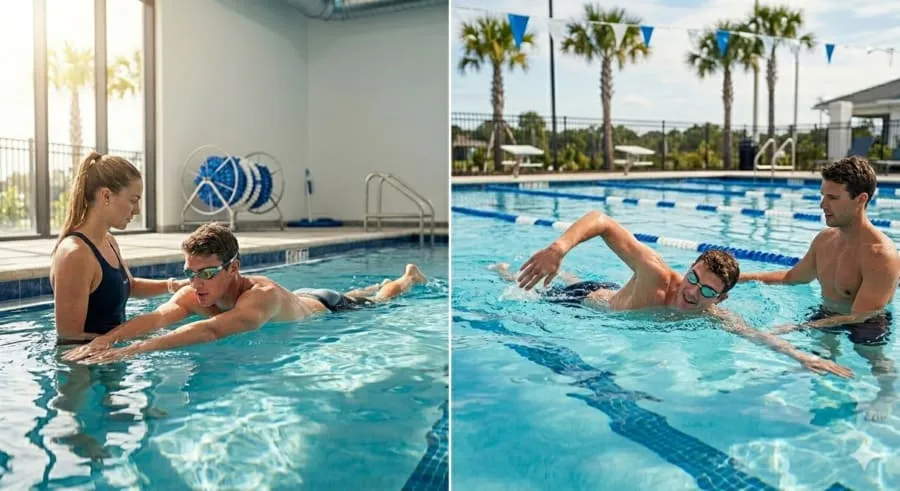
Has this happened to you? (It happens to almost every swimmer eventually.) You feel great in the water, your stroke looks clean, and you are hitting your yardage goals, yet your times just won’t budge. It’s a frustrating wall to hit.
Usually, the missing piece isn’t more laps. It’s what you’re doing - or not doing - on dry land. Transitioning into weight training can feel like a foreign concept when you are used to the weightlessness of the pool. However, finding a certified strength and conditioning specialist in Gainesville can take the guesswork out of the process and ensure your efforts translate into speed.
If you’re tired of the lack of progress, it’s time to build a stronger foundation for your swimming success. Strength training for swimmers isn’t about building impressive musculature. The goal is to increase your power and stability, and to keep your shoulders healthy for the long haul. Here is a roadmap to get you moving in the right direction:
- Understand Your Goals: Identify your objectives for starting strength and conditioning training.
- Choose the Right Exercises: Select exercises to target your main muscle groups.
- Create a Training Schedule: Establish a routine that fits your lifestyle and ability level.
- Get Appropriate Equipment: Invest in quality equipment to help you safely perform exercises.
- Track Your Progress: Develop a tracking system to monitor your development over time.
- Develop an Effective Warmup Routine: Prepare yourself mentally and physically with a warm-up every session.
Define Your Purpose
You cannot hit a target if you don’t know what you are aiming for. To build a program that actually works, you have to understand your goals from the very first day. Are you a sprinter looking to explode off the blocks? Good news: The right strength training can help with that. Or maybe you’re a distance swimmer? Core strength is essential for keeping your hips high during a strenuous 1500. When you clearly understand your goals, you can tailor your lifting to match your specific events.
General fitness is great, but swimmers need functional strength that mimics the demands on their bodies in the water. For instance, if your primary concern is injury prevention, your goals might lean toward scapular stability and rotator cuff health. On the other hand, if you want to drop time in your 50-meter freestyle, your objectives will focus more on raw power and fast-twitch muscle fiber recruitment.
Do Strength/Conditioning Workouts That Deliver Gains in the Water
Once you know why you are training, you need to choose the right exercises. Needless to say, you won’t maximize your benefits if you just wander into a gym and hop on the first machine you see. You want to perform movements that build total-body tension and coordination. Compound lifts like deadlifts, squats, and pull-ups are the gold standard because they engage multiple joints at once.
To choose the right exercises effectively, you also need to account for the physical toll swimming takes on your body. Because swimmers spend so much time in a horizontal, non-weight-bearing environment, they often have lower bone mineral density than land-based athletes. Incorporating weight-bearing exercises like lunges or overhead presses helps counteract this dynamic. It develops the structural integrity needed to handle regular training and high-volume yardage.
Caution: Balance Your Training Load
One of the biggest mistakes athletes make is trying to do too much too soon. When creating a training schedule, you have to consider your entire week, not just your gym time. If you have a massive threshold set in the pool on Tuesday morning, hitting a heavy leg day on Tuesday afternoon is a recipe for burnout.
Instead, create a training schedule that allows for adequate recovery. Most swimmers find that two to three sessions of strength work per week provide the best results without detracting from their swimming performance. It is often better to have a short, high-quality session of thirty minutes than a two-hour marathon that leaves you too sore to maintain proper form in the water the next day.
Don’t Skip the Preparation
It can be tempting to walk into the weight room and go straight to the heavy rack, but you must develop an effective warmup routine. This is especially true for swimmers who often have “tight” chests and “loose” shoulders. You need to bridge the gap between your daily life and the intensity of lifting.
When you develop an effective warmup routine, focus on dynamic movements rather than static stretching. Arm circles, cat-cow stretches, and light resistance band work for the shoulders are perfect for a swimmer’s needs. This process wakes up your central nervous system and ensures your joints are lubricated and ready to handle the load, significantly lowering your risk of a setback.
Gather the Essential Tools
You don’t need a specialized facility to get stronger, but you do need to get appropriate equipment. If you’re starting at home, a set of adjustable dumbbells and some high-quality resistance bands can cover about 90% of what a swimmer needs. Resistance bands are particularly vital for “prehab” work, allowing you to target the small stabilizing muscles around the shoulder that are difficult to hit with heavy weights.
As your strength improves, you may want to get appropriate equipment that offers more resistance, such as a kettlebell or a barbell. However, the quality of the movement is always more important than the amount of weight on the bar. If you aren’t sure about your form, consulting a certified strength and conditioning specialist in Gainesville can help ensure you use your gear safely and effectively.
Keep an Eye on Your Wins
It’s been said that if you don’t measure something, you can’t improve it. You have to track your progress to see how your body is adapting over time. This isn’t just about recording how much weight you lifted so you can feel good about your workouts. It requires close attention, including noting how you felt during the session and how that translated to your next swim.
When you track your progress, look for trends over several weeks. Ask yourself key questions. Are your turns feeling more efficient and powerful? Is your shoulder pain decreasing? Using a simple logbook or a digital app to monitor critical metrics helps you stay disciplined and provides the data needed to adjust your plan when you hit a plateau.
Expert Guidance Makes a Difference
Getting started on your own is a great first step, but there is no substitute for professional eyes on your movement. A certified strength and conditioning specialist in Gainesville can spot technical flaws that might lead to bad habits and injuries down the road.
They understand that a swimmer’s body has specific needs - like maintaining shoulder mobility while building strength - that a general trainer might overlook. By working with an expert, you can move with confidence, knowing that every minute you spend in the gym is making you a faster, more resilient athlete.
Contact Swim Tec to learn about how to start a strength and conditioning program.